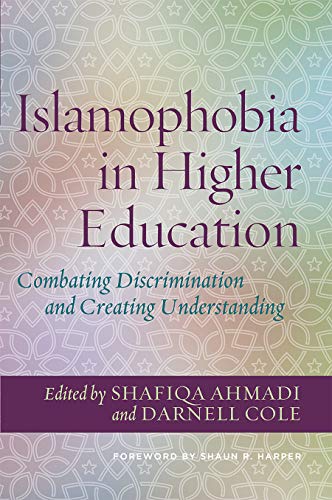
While Islamophobia was present in our society before 9/11, it has become more pervasive in recent years. This is evidenced by the current social and political climate, hate speech and hate crimes directed at Muslims, and the Supreme Court’s upholding of Presidential Proclamation 645 that effectively bans Muslim immigration from coming to the U.S.
What does this mean for Muslim students in college, and indeed for institutions of higher education as they navigate law and policy on the one hand and adhere to their mission of achieving inclusive and equitable educational environments on the other?
This book begins by critically engaging with how current laws and policies institutionalize Islamophobia and affect the intersectionality and diversity within the Muslim community. It includes multidisciplinary voices, such as an international human rights attorney, a civil rights attorney, a criminal law attorney, student affairs practitioners, and research faculty whose work on this marginalized student population are traditionally not recognized within academic settings; and brings the voices of female Muslim scholars to the fore. Each chapter includes a critical analysis of the literature, a legal analysis when appropriate, a set of recommendations for policy and practice, and discussion questions.